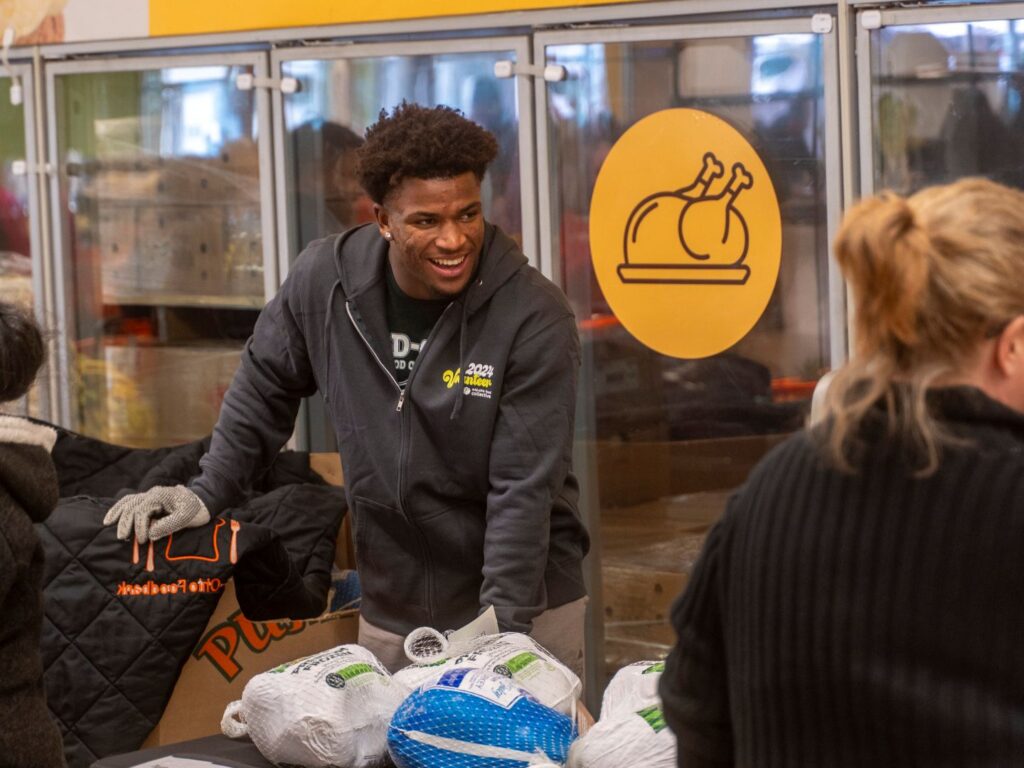
By Jack McLaughlin | Photos by Polly Sellers
This story first appeared in the September 2025 edition of (614) Magazine. © 2025 (614) Media Group. Reproduced with permission.

Liam Layton may be the most famous man on the internet when it comes to cottage cheese.
No, seriously. The New York-raised content creator—now a graduate student in nutrition at The Ohio State University—has made a name for himself on YouTube, TikTok and more via a series of food-related videos that are as witty and sarcastic as they are informative.
His channel, The Plant Slant, often features Layton testing healthy snack hacks, and it didn’t take long before he was flooded with requests to try recipes that rely on cottage cheese as a protein-boosting and calorie-lowering substitute. His reactions to them quickly became one his calling cards as a creator.
“I like cottage cheese, but I eat it out of the container with a spoon like a civilized person,” he said with a laugh. “People on the internet are putting it in everything, and that’s not right. It’s like the new cauliflower.”
And while Layton has carved a comfortable niche for himself as a well-known content creator—meaning he can afford to make as many cottage cheese-related recipes as he wants— it hasn’t always been this way for the popular YouTuber, who grew up on federal assistance food programs like SNAP and WIC.
So when the One Big Beautiful Bill—which resulted in billions of dollars cut from SNAP—passed into law earlier this year, Layton decided to help where he could, sending a $500 donation to Mid-Ohio Food Collective.
“I WOULD SAY HAVING A PLATFORM DOESN’T MAKE ME MORE COMPELLED TO HELP … BUT I REALIZE THAT WITH WHAT I HAVE I CAN MAKE A BIGGER MARK.”
“That happened and I thought, ‘Ok, how are a lot of people going to get food now? Food banks. What’s the closest food bank to me? Mid-Ohio Food Collective,’” he said with the same kind of matter-of-fact pragmatism that has helped win over millions of viewers across the internet.
And while his most recent donation caught the most attention, he has quietly contributed more than once since starting his tenure at OSU, including an earlier instance where he donated the proceeds of a T-shirt design he sold to the food collective.

For Layton, finding ways to give back dovetails neatly with his ideas of content creation and audience engagement: Take a minute to logically walk through the best way to make an impact, and your content—like your donation—will likely make a larger mark.
“It’s like when I make a video, I ask myself: ‘Did it get views? What are people talking about? Is there a recurring theme I can isolate with this and another video that did well,” he said. “You also need to be entertaining and teach people something. I started off doing just informative stuff and nobody watched. At the same time, if you’re just doing a skit, you’re not providing anything.”
Layton finds himself in a unique position, with a captive audience of over a million every month. He recognizes that with more views comes more impact, but the fundamental drive to help is something that’s been there all along.
“I would say having a platform doesn’t make me more compelled to help, I would feel the same compulsion even if I had no viewers, but I realize that with what I have I can make a bigger mark,” he said.
Check out some of Liam’s content on YouTube, TikTok and more @The-Plant-Slant.