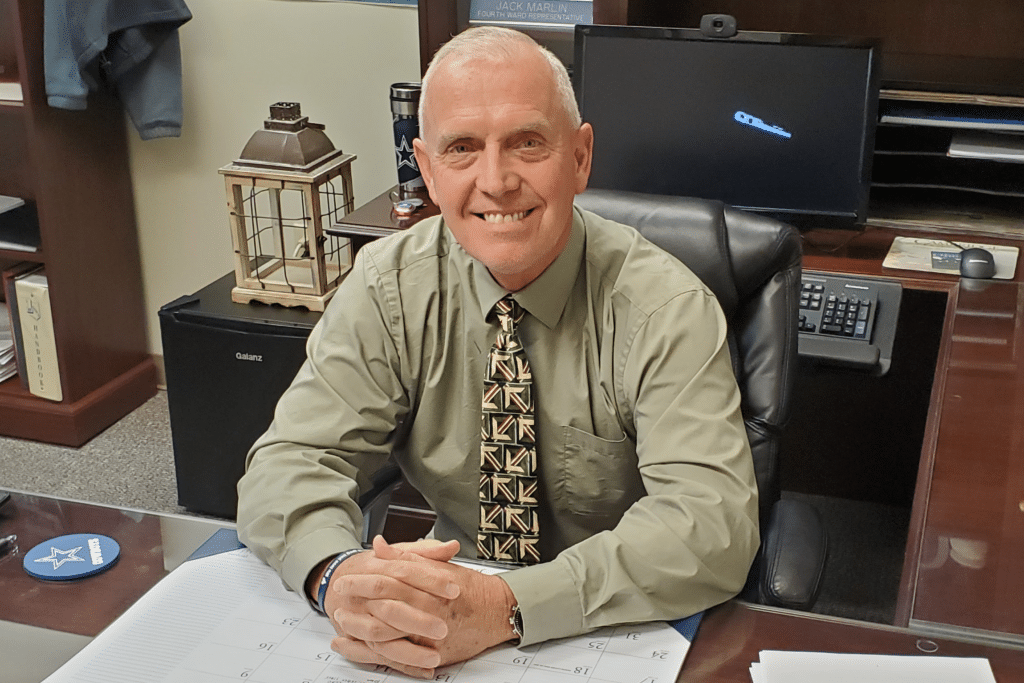
As a retired utility worker, former city councilman, and current Guernsey County commissioner, Jack Marlin has seen what rural hunger looks like at the household, local, and county levels. Now, he’s working to make food security a focus of his time in office.
“I have a servant’s heart. That’s what the Lord gave me,” Commissioner Marlin said. “I’m not a politician. I’m a people person—a public servant.”
Located about an hour east of Columbus, Guernsey County is largely rural with just over 38,000 residents. Roughly 10,000 people live in the county seat of Cambridge with the rest living across the county’s foothills and farmlands. More than 15% of the county’s population lived at or below the federal poverty level as of 2021, according to the U.S. Census Bureau. Guernsey is one of 20 counties served by Mid-Ohio Food Collective, which supplies food to local pantries, soup kitchens, and feeding sites.
Commissioner Marlin first moved to Guernsey County in 1980. Over his 40 years working as a residential service technician for a natural gas company, the husband and father of two visited hundreds of families’ homes. He saw how many of his neighbors struggled to make ends meet.
Hunger is a challenge for many families in Guernsey County, Commissioner Marlin said. While it might not look the same as in a large city, food insecurity is present throughout the rural parts of eastern Ohio and touches every community.
“All the surrounding counties in this area have a little bit of it. And if they’re not willing to observe and admit that, they’re living in a cave,” Commissioner Marlin said. “Hunger is everywhere. It’s just whether your political leaders who can do something about it can recognize it or not. I’ve been to a lot of meetings as an elected official, but I’ve not heard a lot of people talking about hunger.”
Hunger in rural communities presents its own challenges, he said. For instance, transportation is a major barrier. While a person in a big city might be able to take the bus to a grocery store, public transit is limited in many rural places. Rural areas also tend to have fewer food shopping options to start with, which means losing a single grocery store can badly harm a community. It’s something Commissioner Marlin has seen firsthand.
Before being elected to his current position in 2020, Commission Marlin served for 13 years on the Cambridge City Council. The city’s west end had a discount grocery store that closed its doors, and the impact on the neighborhood was immediate. The store was within walking distance for many people who didn’t have cars, and its discount pricing helped poorer residents get by.
“When you pull out a grocery store like that, what do you think is going to happen? A lot of people had nowhere to go. That was a good source to those people, and it was affordable,” Commissioner Marlin said. “When they left, it really decimated that west end of Cambridge.”
The closest supermarket to the former store’s location is two miles away, and the closest major retail cluster is even farther. Commissioner Marlin said the store closing didn’t just impact shoppers. It continues to affect plans for other community projects.
“We’re looking for affordable housing. We’re looking for senior housing. The thing is this: Where we want to put these houses, people have to be able to walk to things,” he said. “If we had somewhere people could shop over there, that would be a good place to live.”
Commissioner Marlin said he’s interested in helping create a space in west Cambridge where local residents can shop, and he hopes to make some headway while he’s in office. One idea he is considering is an MOFC Mid-Ohio Market. More broadly, he hopes to use his position as county commissioner to tackle food insecurity and help his neighbors.
“If you don’t have food, you don’t survive. I hope and pray we can make something happen for the people of Cambridge and Guernsey County, and I’m going to do all I can to help. That’s the only reason I sit in this chair,” Commissioner Marlin said. “This is where I can do the most work. I want to utilize that to help people who want to be helped.”