Whether it’s crops, sustainability efforts, or community connections, Mid-Ohio Food Collective’s Taylor Berschet has always had a passion for growing things. Since childhood, she’s sought out ways of putting her love of nature and her family’s farming roots to work for her neighbors. And since mid-2020, she’s helped expand and improve MOFC’s network of food-growing sites as Mid-Ohio Farm Manager.
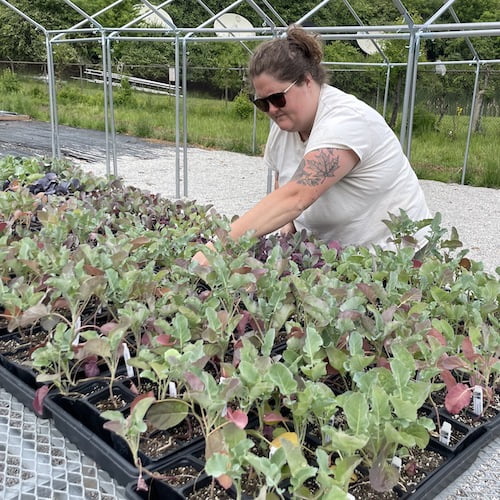
For more than a decade, MOFC’s Mid-Ohio Farm program has been turning unused or vacant lots into food-producing gardens and farms in central Ohio. With the help of volunteers, the MOFC Farm team transforms empty parcels into high-yield farms with vertical growing towers, automated watering systems, and more. Each site grows fresh produce such as leafy greens, sweet potatoes, and carrots. Crops are distributed locally to the Mid-Ohio Foodbank, Mid-Ohio Kitchen, and each farm’s neighbors free of charge through regular produce distributions.
What started as a single site in Columbus has now become two urban farms (one in Columbus’ Hilltop neighborhood and one on the grounds of the NBC4 television station), community gardens, and a high-tech, indoor “freight farm” created and managed in partnership with AEP Ohio.
Taylor said urban farming’s benefits go beyond just growing food. Farms can renew an area’s sense of shared space. They are opportunities for education and job training. They help people take pride in their neighborhoods and give families a place to gather, learn, and reconnect.
“Green space has a positive impact. An urban farm brings in people to visit, provides food to the area, and gives everyone a place to meet each other and hold community events,” Taylor said. “It brings warmth to an area. It’s a welcoming presence and space that’s inviting, encouraging, and grounding.”
Taylor’s appreciation for farming has deep family roots. As a self-described “outdoorsy kid,” she would visit her grandparents’ farm each summer in South Charleston—about 50 miles west of Columbus. While exploring the fields of corn, wheat, and soybeans, she started to grasp the challenges and importance of traditional agriculture. The farm property was 800 acres (more than 100 times the size of the Mid-Ohio Farm on the Hilltop). The scale was impressive but intimidating.
“I grew up going to the farm but not really getting my hands dirty. Farming was always a presence in my life, but it didn’t cross my mind that agriculture could be a focus for me,” Taylor said. “The family farm seemed so unattainable at a younger age.”
It wasn’t until she took a high school environmental science class that she started to see how sustainability, food production, and environmental justice fit together. She learned how everyday people—including farmers and women activists—have advocated to protect soil and water quality. Taylor credits her science teacher Mr. Redding with helping her understand how her family’s farming roots could empower her to help her neighbors and the earth.
“He opened my world to a whole new perspective, not only on environmental issues but on how environmental and social issues are entangled,” Taylor said. “It brought together all the things I cared about—the history of our impact on the planet and where we’re going.”
As an undergraduate in the Ohio State University’s Environment, Economy, Development, and Sustainability (EEDS) program, Taylor interned at a small farm northeast of Columbus. It was there she began to see a path for herself in agriculture and understand the role that farming can play in environmental sustainability.
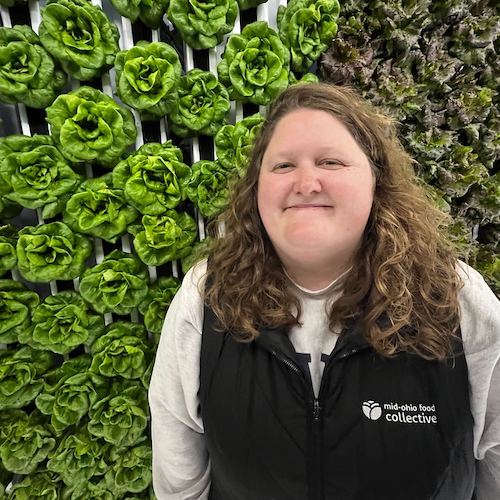
Mid-Ohio Farm properties do not use pesticides. MOFC staff plant pollinator gardens. The farms recirculate and reuse water, and vertical growing towers allow for highly efficient yields—a farm using the towers can produce up to 20 times more produce per square foot than one without. The Mid-Ohio Farm program’s relatively small size makes it easier to try new things and build on traditional agriculture knowledge. New, sustainable techniques are complementary to traditional ones, not replacements for them, Taylor said.
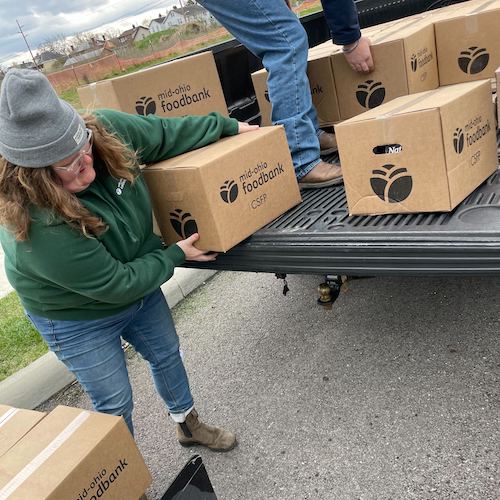
Taylor graduated from OSU in 2017. She joined the MOFC farm team in July 2020 and was promoted to Farm Manager in March 2021. Looking ahead, she said she hopes to grow the Mid-Ohio Farm program in three big ways.
First, she wants to keep connecting with other urban farmers in central Ohio and lift up the movement to raise local, fresh produce on available land. Second, she wants to educate the public on the impact of agriculture and the proud traditions behind it. And third, she wants to inspire the next generation of farmers—whether they tend their crops in wide open spaces or vacant city lots.
Looking back, Taylor said her food perspective has evolved since she became a full-time farmer herself. Her respect for traditional agriculture has only grown.
“If people saw everything you need to run a farm, they’d think of farmers differently. You need business sense. You need to understand soil conditions and technology,” she said. “I’m really moved by farmers and everything they do.”
There are many differences between the farming her grandparents practiced and what she does for MOFC, Taylor said. But she’s proud of the fact that they are united in working the land. In other farmers, Taylor said she sees kindred spirits who are neighborly, community-minded, entrepreneurial, and kind.
“You feel it when you meet other farmers. There’s a mutual appreciation for the earth, what you provide, and the pride they feel in where they’re from,” Taylor said. “That’s what I want to grow here with our neighbors and fellow farmers.”