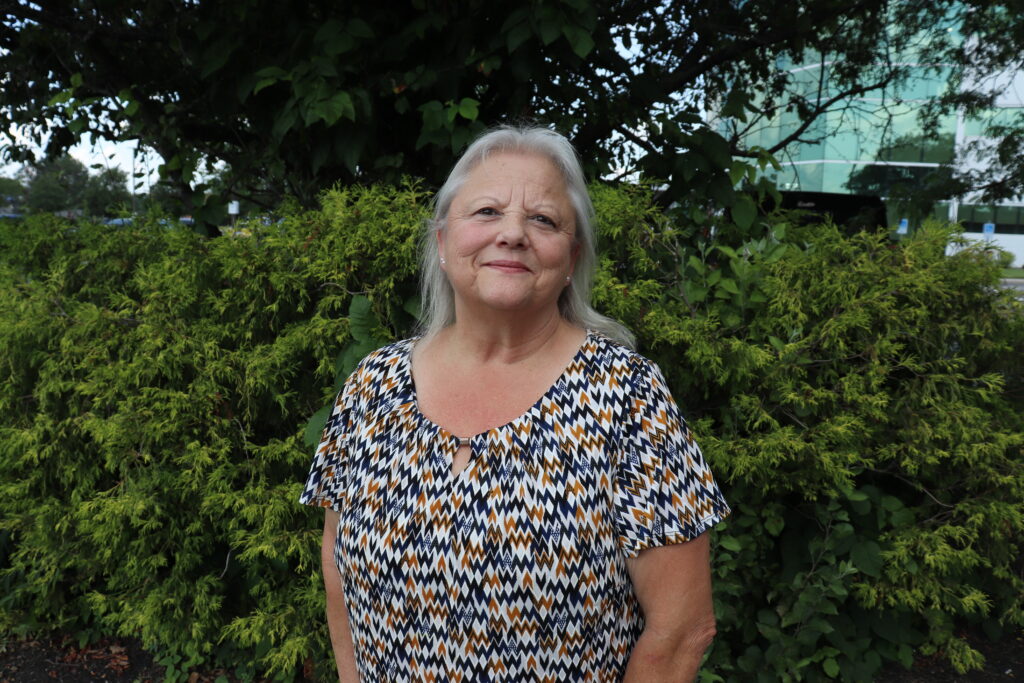
Circleville resident Scott Bower talks proudly of how hard working and self-reliant he was before health problems forced him to retire. The 68-year-old former business owner would have laughed at the idea of needing to visit a food pantry 20 years ago. Now, it’s a lifeline for him and a growing number of his neighbors.
“You never know you’re going to have to go somewhere like this when you’re younger and making money,” Scott said while waiting in line at Emergency Clearinghouse Food Pantry, a Mid-Ohio Food Collective partner agency in Circleville.
For more than 17 years, Scott ran a mobile tool truck and rented gear to construction crews in Lancaster, Groveport, and rural areas in central Ohio. The business was successful enough for him to start a family and buy a home. Life had its ups and downs, but Scott knew he could make a living with his hands as long as he had his health.
“I was big and strong and intelligent. I felt I could do whatever I wanted. Drive a truck, drive a tractor, sell parts. I worked hard and worked hard and kept working hard,” Scott said. “But when you get to the point where you can’t walk or talk without catching your breath, well, what do you do?”
One day was all it took for life to change. While he was recovering at the hospital from what was expected to be a low-risk cardiovascular procedure, Scott suffered a major heart attack that stopped his pulse completely for several minutes. His doctors were able to revive him, but the recovery kept him in the hospital and out of work for a month.
After Scott was discharged, his heart was working at just 15% of its normal capacity. With bills piling up and physical work no longer an option, he was forced to sell his business and the tools from his truck at a steep loss.
Financial problems snowballed. They eventually cost Scott his home. At a low point, he remembers making a full meal out of shredded cabbage mixed with mustard and mayonnaise. The simple ingredients were all he had. Three years ago, he sought out help with food for the first time.
These days, Scott visits Emergency Clearinghouse regularly. He also picks up a Commodity Supplemental Food Program (CSFP) box of shelf-stable goods once a month. The boxes are federally funded, packed by MOFC, and distributed to low-income seniors by local pantries and senior centers. He’s also enrolled in the Supplemental Nutrition Assistance Program (SNAP) and qualifies for Social Security, but strict income limits on these programs make it hard to make ends meet.
“My food stamps went down because I started making an extra $30 per month in Social Security,” said Scott, shaking his head. “I’m still losing because I got an extra $30? I’d love for someone in charge to explain to me how that makes sense.”
Scott said the world has “changed tremendously,” and his neighbors are struggling. He’s noticed the kind of homelessness he used to see only in big cities—people living in camps outside—becoming more common in Circleville. And as inflation has gotten worse, he’s watched the lines at the pantry grow.
“It’s harder out here for the normal person. Look at the people behind me. This line wasn’t 18 cars long three years ago,” Scott said. “We need somebody to care about us.”