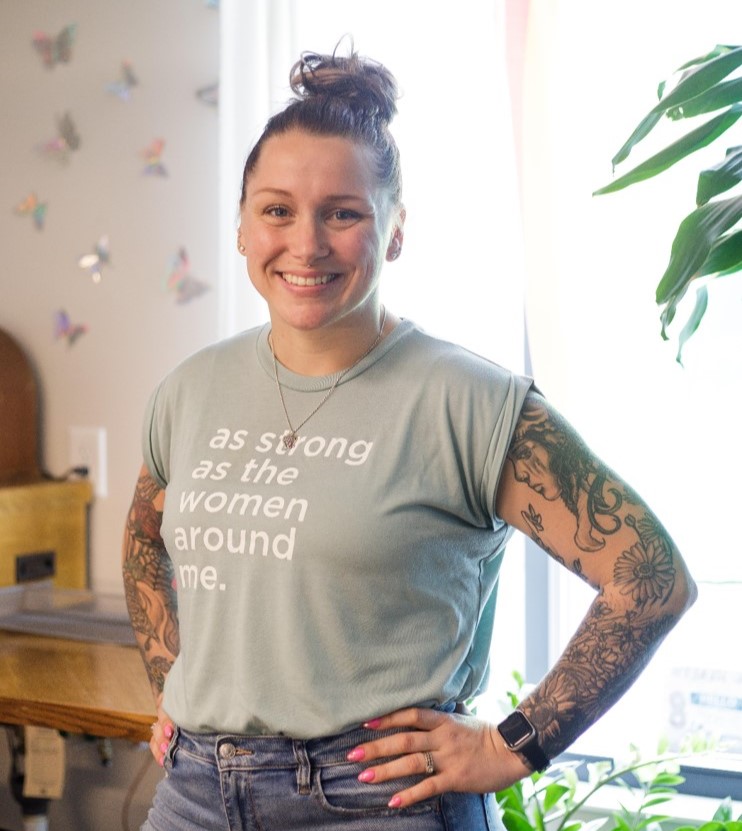
Editor’s Note: This story contains accounts of child neglect, human trafficking, sexual coercion, sex work, and drug use and may not be suitable for all readers. If you are a victim of human trafficking or know someone who is, help is available. Call the 24-hour national hotline at 888-373-7888 and click here to learn the warning signs of human trafficking.
Mandie Knight speaks matter-of-factly about her life. It’s the only way she knows how. More than that, it shows the people she helps—many of whom are still trapped in Columbus’ sex trade—that she understands what they’re going through.
Growing up in Columbus’ Franklinton neighborhood with a mother who struggled with addiction, Mandie lived through intense poverty, hunger, and neglect. As an adult, she has been sex trafficked three separate times and struggled with addiction herself. She knows that not having enough to eat is what sets many people on the path to what she calls “the life.” Becoming food secure is often the first step out of it.
Mandie doesn’t live “the life” anymore. In fact, she has dedicated herself to helping others escape it. With help, she left sex work in 2016 and now serves as operations director at Sanctuary Night, a nonprofit on Columbus’ west side that provides womxn (a gender-inclusive term that the agency uses in its mission statement) with food, company, and a safe place to rest, wash, and eat. Mid-Ohio Food Collective (MOFC) helps stock Sanctuary Night’s cupboards with everything from soap and laundry detergent to produce. Food provided to the shelter for free from the Mid-Ohio Foodbank goes into prepared meals and snacks.
“We break bread together here. What we do at Sanctuary Night is centered on food,” Mandie said. “Food is a fork-in-the-road decision maker. People will do unimaginable things to eat, and they shouldn’t have to.”
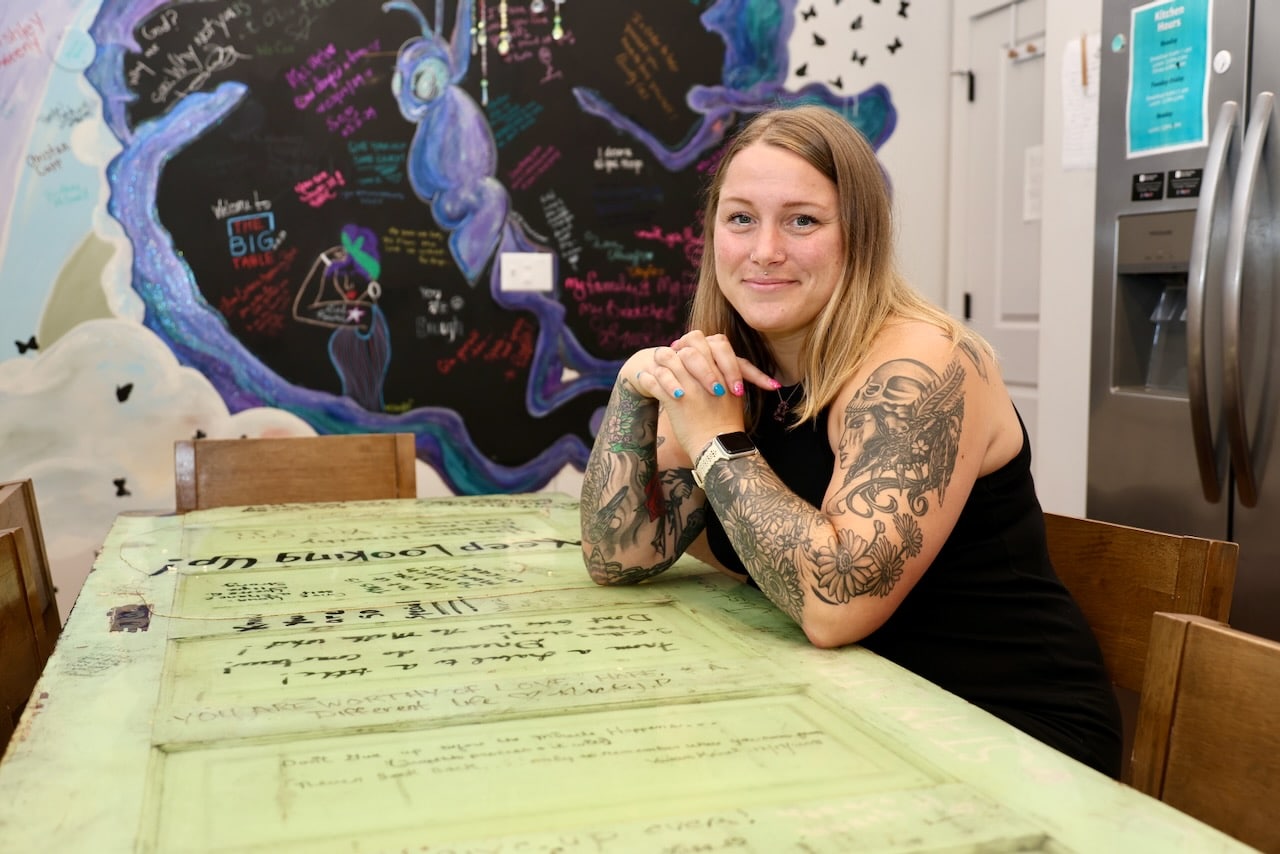
at Sanctuary Night on Columbus’ west side.
Food insecurity was a daily reality for Mandie as a child. There was rarely much to eat in her mother’s house, she said, and she can’t remember the family ever sitting down for a meal together. She remembers visiting food pantries often as a kid.
In addition to food scarcity and poverty, Franklinton was hit hard by Ohio’s opioid epidemic. Mandie’s father wasn’t in her life then, and she said her mother would often disappear for long stretches of time to use drugs. That left the 6-year-old Mandie home alone as the sole caregiver for her infant brother. Mandie said that when she got chicken pox, her mother left the children with one juice box, a toaster pastry, and whatever else they could find. Most days, that meant ramen noodles.
“I remember making ramen noodles and sharing them with my brother,” Mandie said. “My 6-year-old little self crouched on the counter on my little feet, over the stove, trying to figure out how to make them.”
There were good food memories between the bad. Mandie enjoyed eating at the cafeteria at school, and she often walked the two blocks to her great grandmother’s house where she could sometimes get potato chips and soda—rare treats at home. The households felt worlds apart.
“I’ve always had the core memories, and they had so much to do with food. Food was about being taken care of,” she said. “Great grandma’s house is a colorful memory versus the dull, gray memory of home.”
Every day was about survival. Money was tight through her young adulthood, and as a single mother at 19, Mandie had to find a way to make ends meet. When a friend’s boyfriend offered to pay her bills, buy groceries, and cut her in on a business opportunity, it was too good to pass up.
The “opportunity” turned out to be sex work, and Mandie needed the money badly enough to go along with it. The first time, it was easy and quick. Then, the man demanded money for the food and utilities he’d paid for. More sex work followed, and before Mandie knew it, the man had become her trafficker.
“He got me on my vulnerability of being financially insecure, being unable to care for myself and my son as a first-time single parent,” Mandie said. “Traffickers seek out your vulnerabilities. It’s like they can smell them a mile away.”
Hundreds of people are targeted by sex traffickers in Ohio every year.[1] According to the National Human Trafficking Hotline, there were more than 250 human trafficking cases reported in Ohio in 2023. Most of the 458 victims identified in those cases were women coerced into sex work, according to hotline data.[2]
Mandie’s father—at that point in addiction recovery and back in her life—got custody of her young son. Her friend who’d introduced her to her trafficker died of an overdose. And Mandie, now alone, was moved to Chillicothe where her trafficker had a house. She was technically free to leave, but the control her trafficker had over her was strong.
“If someone had asked me in the moment, ‘are you being forced to stay here,’ I would have said no. I thought I was safe and protected and taken care of. It took a long time of healing to recognize what that was,” she said.
Psychological abuse is the most common control tactic used by traffickers.[3] Victims can be led to believe that traffickers are protecting them (often from the situations and dangers the traffickers themselves create).[4]
Before she got out of “the life,” Mandie would be trafficked two more times by other men in her home city of Columbus. Much of that time was spent seeking out customers near Sullivant Avenue—the same neighborhood she now supports through her work at Sanctuary Night.
Over the years, she was a drug user herself and struggled with addiction, experiencing firsthand how food insecurity, sex work, and substance use are linked. Mandie said that for unhoused people, it can make more sense to spend money on drugs than on food. A few dollars won’t go far at a corner store. But at a drug dealer’s house, it can buy temporary shelter. Dealers may let customers sit inside for a while or use the bathroom—maybe even shower.
And when it comes to getting off drugs and escaping the poverty that can make sex work necessary, food insecurity comes into play again. Appetites come back when people get clean, and it can be less painful and expensive to relapse than to find stable help with food, Mandie said.
“There are times I’ve done sex work just for food. I’d get in a guy’s car and say, ‘can you please take me to the drive-through, just something from the dollar menu,” Mandie said. “Someone once told me, ‘I know if I do $10 worth of meth, I won’t be hungry for a week.’ How many people get high because it’s easier than finding something to eat?”
For Mandie, things changed in early 2016 when she entered Franklin County’s CATCH (Creating Autonomy Through Collaborative Healing) Court program. At the time, it was a new approach to helping people exit sex work and escape their traffickers. The community meals, in particular, helped with the healing process.
“You’d have the public defenders, the judge, the court staff, and the CATCH participants all sharing a meal together like normal people,” Mandie said. “I felt like I belonged.”
Mandie completed the CATCH program in 2017, and that led her to her work with Sanctuary Night. Since then, she’s regained custody of her son, earned her associate’s degree, and worked with the Ohio Attorney General’s Human Trafficking Commission. Every day, she brings her experience to the work on Sullivant Avenue and the neighborhood she knows well from her time in “the life.”

As ever, much of the work is centered on food, and much of that comes from MOFC. Womxn have access to the shelter’s shared kitchen at all hours. Meals are planned and served at regular times. Regardless of the time of day, no one leaves hungry if Mandie can help it. To her, it’s about giving others the help she didn’t have.
“We want to eliminate the barriers to people’s basic needs. The fact that we have Mid-Ohio Food Collective makes it possible to serve as many people as we can. Even if it’s not a mealtime, we never say ‘no,’” Mandie said. “The people we serve, like me, have been told ‘no’ for basic needs their entire lives. We get to break the cycle, and that is a beautiful thing.”
[1] https://ocjs.ohio.gov/anti-human-trafficking/data-and-reports/00-ohio-human-trafficking-cases-victim-data
[2] https://humantraffickinghotline.org/en/statistics/ohio
[3] https://www.ctdatacollaborative.org/story/victims-americas
[4] https://www.psychologytoday.com/intl/blog/modern-day-slavery/202304/understanding-the-mindset-of-a-human-trafficking-victim